

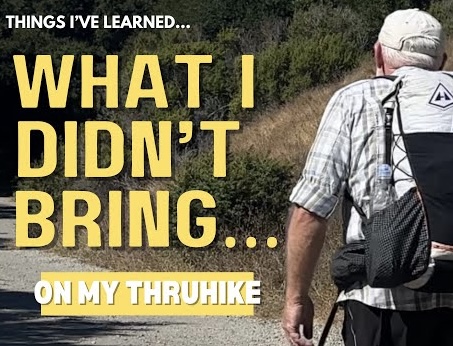
Today’s devotion builds on yesterday.
“Therefore, since we have so great a cloud of witnesses surrounding us, let us also lay aside every encumbrance and the sin which so easily entangles us, and let us run with endurance the race that is set before us,” (Hebrews 12:1, NAS95)
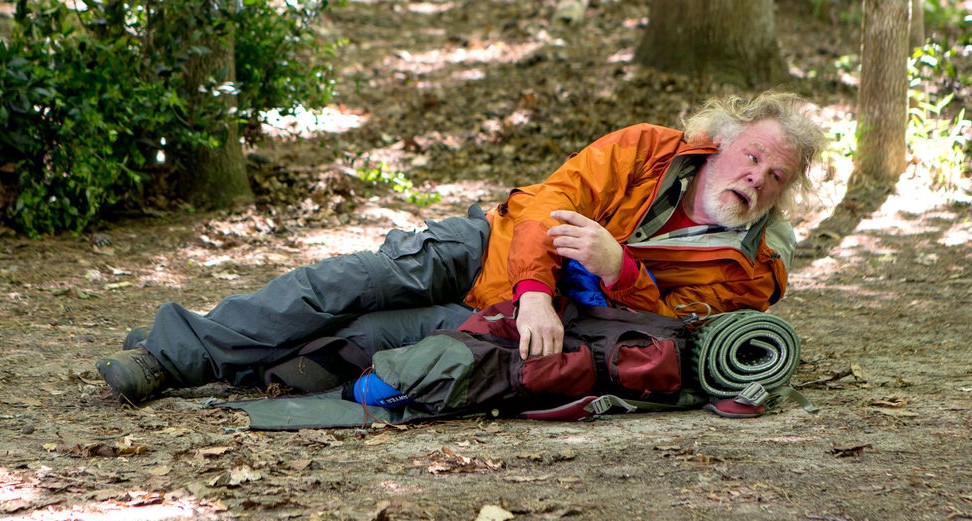
I tend to learn things the hard way…making mistakes myself instead of learning from those who have gone before me. The first time I hiked the Appalachian Trail I had a bunch of stuff I thought I needed and didn’t have an important essential that I thought the trail would provide—water. As a result, I earned the trail name “Katz” after the character from the movie “A Walk in the Woods”.
There are individuals so prepared they actually run the Appalachian Trail. That specific pursuit is called Fastpacking, and when someone tries to do it in record time, it’s known as an FKT (Fastest Known Time) attempt. It is a hybrid between ultra-running and lightweight backpacking. You aren’t just “going for a run,” and you aren’t just “going for a hike”—you are moving at a sustained, efficient pace over hundreds or thousands of miles, carrying only the bare essentials.
In 2015, Scott Jurek ran the entire 2,189-mile Appalachian Trail in 46 days, 8 hours, and 7 minutes. To do that, he had to average nearly 50 miles a day for over six weeks.

Fastpacking brings a unique technical challenge that mirrors the sermon’s call to “throw off every hindrance.” In Fastpacking, every single ounce in your pack is a “tax” on your endurance. If you carry a “just in case” item that you don’t actually need, you are spending energy on a weight that provides no value.
Day 2: The Biomechanics of Hindrances
The Core Concept: The Coefficient of Drag & Base Weight
In engineering and kinesiology, the more mass you carry, the more energy is required to move it. In the world of an FKT runner on the Appalachian Trail, there is a concept called Base Weight—the weight of your gear before adding food and water. If your base weight is too high, your joints will fail, and your “Pace of Grace” will become a “Grind of Grief.”
The Spiritual Isomorphism
The sermon mentions that we are a “work in progress” and “messed up folks”. Often, the reason we feel “messed up” or exhausted isn’t that we lack faith; it’s that we are trying to run our race while carrying unnecessary base weight.
Throwing Off Hindrances:
Hebrews 12:1 tells us to “strip off every weight that slows us down.” In fastpacking, this means cutting the handle off your toothbrush to save half an ounce. In life, this is the “due diligence” of identifying things that aren’t necessarily “sins,” but are “weights”—distractions, old grudges, or the need for approval—that make the “moving forward” harder than it needs to be.
Shedding the “Base Weight” (The Past & Anxiety)
“Brethren, I do not regard myself as having laid hold of it yet; but one thing I do: forgetting what lies behind and reaching forward to what lies ahead, I press on toward the goal for the prize of the upward call of God in Christ Jesus.” Philippians 3:13-14 (NASB95)
This is the spiritual equivalent of leaving things at the trailhead. Paul is actively choosing not to carry the “base weight” of his past—whether past successes that might make him complacent, or past failures that would bog him down in guilt. He is traveling light.
“…casting all your anxiety on Him, because He cares for you.” 1 Peter 5:7 (NASB95)
Anxiety is the ultimate “just in case” weight. We carry worries about the future like heavy gear we might need but usually don’t. Peter’s instruction to “cast” it is an active, intentional shedding of that encumbrance.
The Logistics of the Long Haul:
Scott Jurek didn’t reach the finish line by thinking about the 2,000 miles. He reached it by focusing on the Due Diligence of the next mile. The sermon says we must do our “duty until the day we get called up”. Endurance is the science of breaking a massive goal into manageable, weighted steps.
Focusing on the Next Mile
“So do not worry about tomorrow; for tomorrow will care for itself. Each day has enough trouble of its own.” Matthew 6:34 (NASB95)
This perfectly mirrors the discipline of the FKT runner who refuses to think about the 2,000 miles ahead and focuses only on the immediate terrain. Jesus is teaching the ultimate “due diligence” of the present moment—managing the terrain you are standing on right now.
“Your word is a lamp to my feet and a light to my path.” Psalm 119:105 (NASB95)
Notice that a lamp (especially an ancient one, or a modern headlamp on the trail) doesn’t illuminate the entire 2,000-mile journey. It only illuminates the next step. It requires trusting the Trail Guide for the macro-journey while you manage the micro-steps.
The Support Crew:
No one sets an FKT alone. They have a “crew” that meets them at road crossings with fresh shoes and food. This mirrors the “messed up folks” the preacher mentioned—the community of believers who provide the “logistics of love” so you can keep your forward motion.
Community
“Two are better than one because they have a good return for their labor. For if either of them falls, the one will lift up his companion. But woe to the one who falls when there is not another to lift him up.” Ecclesiastes 4:9-10 (NASB95)
The trail is treacherous. Whether it’s the Appalachian Trail or the Christian Life, having a support crew isn’t a luxury; it’s a matter of survival. You aren’t meant to do it alone. This verse highlights the danger of trying to fastpack the spiritual journey in isolation.
“Bear one another’s burdens, and thereby fulfill the law of Christ.” Galatians 6:2 (NASB95)
This speaks directly to the “crew” that meets the FKT runner at the road crossings. We aren’t meant to carry our packs entirely alone. A healthy spiritual community helps shoulder the weight of our “messed up” circumstances so we can maintain our forward motion.
Reflective Question for Day 2: If you were “fastpacking” your spiritual journey right now, what is one piece of “base weight” (a worry, a habit, or a past failure) that you are carrying “just in case”? What would happen to your pace if you chose to leave it at the next “trailhead” and trust in the Finished Work of our Trail Guide instead?
Lord, our ultimate Trail Guide,
Thank You for marking out the path before us. We confess that we often start our journey carrying heavy, unnecessary “base weight.” We pack our past failures, our grudges, and our “just in case” anxieties, fearing that Your grace won’t be enough to sustain us. Forgive us for the times we try to carry it all ourselves, exhausting our souls and slowing our pace.
Give us the courage and the wisdom to ruthlessly audit our packs. Help us to leave every encumbrance, distraction, and entangling sin at the trailhead. Teach us the discipline of the lightweight soul, so we can run this race with joy and endurance, trusting fully in the finished work of Jesus rather than our own overloaded efforts.
When the 2,000-mile journey feels overwhelming, shrink our focus to the due diligence of the very next mile. Keep our eyes fixed on You, trusting that You will provide the light for our next step. And Lord, thank You for our “support crew”—the beautiful, messy community of believers You have placed in our lives. Help us to humbly accept their help at the road crossings, and give us the strength to help bear their burdens in return.
In Jesus’ name, Amen.
Tomorrow we will look at Mitochondrial Adaptation and “The Gift of the Burn.”
 Digital Footprint Disciples
Leave a comment